By Mario E Torres
September 2026
Blog Post #001
I. The Ugly Little Man
II. Why Is Sin an Issue?
III. How Is Sin Described?
IV. What Is the Definition of Sin?
V. Where Can I find Examples of Sin?
VI. Who Is a Sinner?
VII. The Way Ahead
I. The Ugly Little Man
“Man looks on the outward appearance, but God looks on the heart.”1
Many years ago, when I was in Basic Military Training, an instructor walked by as I stood at attention, stopped in front of me, looked at me and said, “You’re an ugly little man.” This event stuck with me over the years and I often revisit the experience, asking myself the following question: what did he mean by those words? In my younger years, I thought myself a fairly handsome fellow, with the exception of a slight imperfection or two. Needless to say, I remained puzzled. As I aged physically, my spiritual life slightly matured, and along the way I read Scripture more frequently and came across the above passage in the book of Samuel. As I further studied and meditated on Scripture, I began to understand some of the core beliefs of the Christian faith, sin and grace being rooted at the center. As I read and learned more about sin, I also began to reflect more on what that instructor said to me many years ago.
While that military instructor saw something “ugly” in my external appearance, I began to see that there was something “ugly” in my inner being. That something was sin. And although this realization was accurate, it fell short of fully describing the seriousness of sin in general, and the depth of my sins specifically. I had a deficient understanding of sin. When I learned about murder for example, I felt relieved that I was not guilty of such sin. When Jesus further expounded on anger being a precursor to murder, I was thrilled that I was not guilty of raging anger. I was humbled when I realized holding grudges and resentment are forms of anger. When I learned about pride, I felt good that I was not an arrogant individual, not realizing self-pity was a form of pride. Learning that it wasn’t just doing things that dishonor God (Sins of commission) but not doing the things that honor God (Sins of omission) also impacted me.
It wasn’t until I engaged in a structured discipleship program with the C.S. Lewis Institute that I understood and fully comprehended what that instructor saw many years ago: The Ugly Little Man. Except I did not see “it” in my physical appearance but rather in my spiritual state and the appearance of my soul. The more I learned about sin, the more aware of it I became, and the more exposed I felt. It is often said that we read the Bible, but the Bible also reads us. It is like looking at the mirror of your soul. The more I looked, the more horrified I became. I began to mourn as I understood the seriousness and depravity of my sins. Yet I was comforted by the weight of God’s love and His gift of grace.
II. Why Is Sin an Issue?
Sin Changes Our Relationships
Chasm:“But your iniquities have made a separation between you and your God, and your sins have hidden his face from you so that he does not hear.”2
Sin created a chasm between God and His children, leading to separation. In the book of Genesis, we learn that God banished Adam and Eve from Eden.3 They no longer enjoyed walks, fellowship, and communion with Him; the relationship changed. Disobedience to God led to that separation. A similar dynamic occurs in God’s relationship with Cain. The sin committed by Cain also created a chasm between him and God, leading to separation. Afterwards Cain responds, “Behold, you have driven me today away from the ground, and from your face I shall be hidden.”4
Conflict:“Cain spoke to Abel his brother. And when they were in the field, Cain rose up against his brother Abel and killed him.”5
Sin created conflict between siblings. Cain’s internal sin of jealousy led to further conflict with his brother Abel. God talked to Cain about getting sin under control, something he was unable to do. Sin created conflict between husband and wife. Moving forward, there would be tension between husband and wife as a result of sin.6 Sin created conflict between parents and their children. The book of Samuel tells the story of King David and his son Absalom.The sin committed by Amnon not only led to conflict between him and his father, the king, but also generated conflict between his father and his other son, Absalom.7 Sin created conflict within man. There was an internal struggle in Cain. God tells him “Its desire is contrary to you.”8 This implies tension, competition, a tug of war going on internally. Sin created conflict between people. Human history “is largely a record of crime, war, disease, and terror.”9 In all these scenarios, the relationships changed. Where there were once harmony, fellowship, communion, and delight, there were now chasms and conflict.
Sin Changes Our Nature
Blindness:“Whoever hates his brother is in the darkness and walks in the darkness, and does not know where he is going, because the darkness has blinded his eyes”10
Sin creates blind spots that keep us from seeing the immediate reality and dangers lurking. For example, Cain was blinded by anger he felt for his brother. That blindness prevented him from seeing murder lurking around. Thomas Tarrants argues that we are blinded by our sins because we cannot or do not want to see them or face them.11
Disorientation: “For although they knew God, they did not honor him as God or give thanks to him, but they became futile in their thinking, and their foolish hearts were darkened”12
Sin disorients us. We begin to lose sight of who we are, sons and daughters of God. Cain lost sight that life is sacred because we are created in God’s image. He lost his moral compass and ultimately killed his brother. Thomas Tarrants points to a change in our center of gravity, instead of outward focus, we become inward focused, self-centered vs. God-centered.13
Lukewarmness: “I know your works: you are neither cold nor hot. Would that you were either cold or hot! So, because you are lukewarm, and neither hot nor cold, I will spit you out of my mouth”14
Sin destroys our zeal almost to the point where we don’t care anymore. Cain’s response to God, for example, displayed an indifference toward the seriousness of his sin. When God asked him about his brother, his reply was nonchalant, almost disrespectful, “Am I my brother’s keeper.”15
Decay: “The LORD saw that the wickedness of man was great in the earth, and that every intention of the thoughts of his heart was only evil continually”16
After Cain, the pattern of violence continued among his descendants. For example, one of his descendants boasted about murder, comparing his violence to Cain’s. 17
Sin Changes Our Future
Death: “For the wages of sin is death, but the free gift of God is eternal life in Christ Jesus our Lord”18
Cain’s sin resulted in Abel’s physical death, illustrating the destructive consequences of sin. After Cain became a fugitive and a wanderer, we see depravity and violence continuing among his descendants, but also spreading into humanity in general. Later we see depravity in the time of Noah. Wickedness and corruption in the human heart continued to increase and bring about death.19
Damnation: “And these will go away into eternal punishment, but the righteous into eternal life”20
According to the Bible, unchecked and unrepentant sin leads to spiritual death, ultimately culminating in the second death. This death leads to permanent separation from God, or damnation.
Sin introduced physical death and spiritual separation from God. We were meant to live forever in perfect fellowship and communion with God and His creation. Sin changed that trajectory, our future now involved death, judgment, and separation from God.
III. How Is Sin Described?
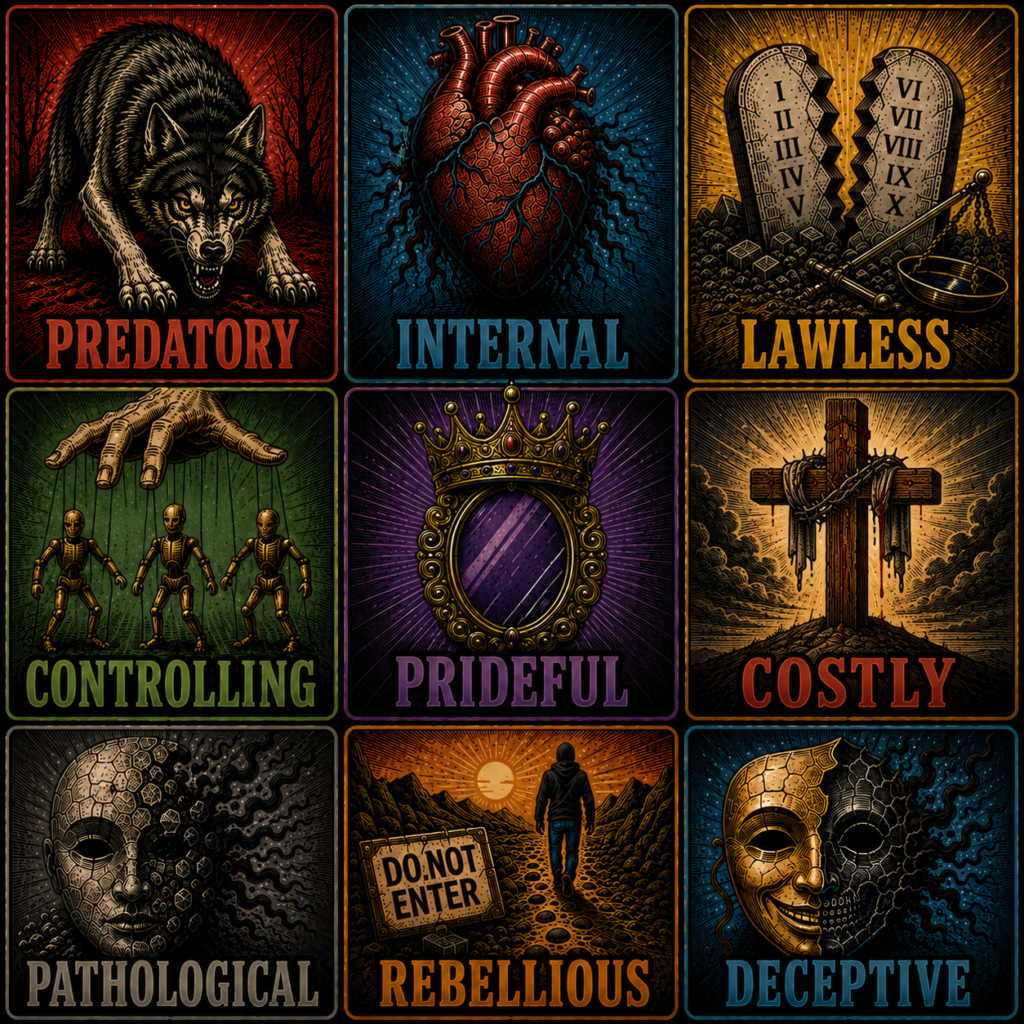
Sin is predatory: “Sin is crouching at the door”21
God describes sin as predatory in the passage above. Crouching is a posture animals take when preparing to attack. A posture that allows a predator to remain concealed while waiting for an opportunity to strike.
Sin is internal: “You have heard that it was said to those of old, You shall not murder: and whoever murders will be liable to judgment. But I say unto you that everyone who is angry with his brother will be liable to judgment”22
Jesus Christ describes sin as internal. He teaches that sin originates in the heart. In the Sermon on the Mount for example, Jesus expounds on two of the Ten Commandments, murder and adultery, and links them to anger and lust. This conveys an internal aspect of sin, linking internal intentions to external behaviors.
Sin is lawless: “Everyone who makes a practice of sinning also practices lawlessness; sin is lawlessness”23
The Holy Spirit is said to convict us of our sins. In a court of law, someone is typically convicted if they have broken a law. In this context, sin can be understood as lawlessness.
Sin is Controlling: “For I do not do the good I want, but the evil I do not want is what I keep on doing”24
St. Paul writes about his struggles, doing things against his will. This implies that sin attempts to exert influence in our lives, making it something we must recognize and address.
Sin is prideful: “Pride leads to every other vice: it is the complete anti-God state of mind”25
Pride can be a gateway to many other sins.26 Since pride often underpins other forms of sin, sin can involve an element of pride and can therefore be described as prideful.
Sin is pathological: “We are all invalids in God’s hospital”27
Dr. Thomas Tarrants states that sin is a “condition” of the heart.²⁸ Psychologist Dr. William Backus argues that, in some situations, “sin may be the pertinent issue.”²⁹ Tarrants emphasizes the condition of sin itself, while Backus recognizes that sin may be an underlying factor in some situations that present as other forms of distress.
Sin is rebellious: “Remember and do not forget how you provoked the LORD your God to wrath in the wilderness. From the day you came out of the land of Egypt until you came to this place, you have been rebellious against the LORD”30
This passage follows the pattern of Adam and Eve, Cain, Noah’s generation, David, human history, and present day. The rebellious nature of sin does not change, nor our propensity towards it.
Sin is deceptive: “The serpent deceived me”31
In the Garden of Eden, the serpent deceived Eve by contradicting God’s command and causing her to question God’s word. The deception presented an alternative to God’s truth, making disobedience appear desirable. Sin is deceptive because it rarely presents itself for what it truly is; instead, it disguises its consequences and appeals to our desires.
Sin is Costly: “For God so loved the world, that he gave his only Son, that whoever believes in him should not perish but have eternal life.”32
The cross reveals the ultimate cost of sin: God gave His only Son to redeem us from sin and death.
IV. What Is the Definition of Sin?
The following definitions of sin can be found in biblical and non-biblical sources:
“Everyone who makes a practice of sinning also practices lawlessness; sin is lawlessness”33
“Any transgression or want of conformity to the law of God”34
“Any failure to conform to the moral law of God in act, attitude, or nature”35
“An immoral act considered to be a transgression against divine law; an act regarded as a serious or regrettable fault, offense or omission”36
“To miss the mark”37
“To miss the mark; to do wrong”38
“Fault; error; mistake; transgression”39
“An offense against God or against a religious or moral law”40
“A rejection of God’s authority over us”41
Disobedience to the Word of God42
Taken together, these definitions portray sin as something serious—a wrongdoing measured against the holy standards and authority of God. Sin tends to be minimized, joked about, or dismissed altogether, but the definitions above point to the contrary.
V. Where Can I Find Examples of Sin?
Now that we’ve seen how seriously Scripture and scholars alike treat sin, we turn to where you can examine examples for yourself.
The Bible provides many clear examples of sin.
God provides the Ten Commandments in Exodus 2043
God explains further in the Sermon on the Mount beginning in Matthew 544
God provides examples in Revelation 2145
St. Paul in Romans 1 and 13; 1 Corinthians 5 and 6; Galatians 5; Ephesians 4 and 5; 2 Timothy 346
St. Peter in 1 Peter 2 and 447
St. John in 1 John 1, 2, and 348
King David in Psalms 749
King Solomon in Proverbs 150
The Prophet Isaiah in Isaiah 151
Early and medieval Christian theologists provided reflections on sin.
Aurelius Augustine writes about the influence of sin in our formative years in The Confessions52
Thomas Aquinas writes about sin and action in Summa Theologiae53
Modern and Contemporary Christian apologists also provide commentary on sin.
C.S. Lewis writes about the “Great Sin” in “Mere Christianity”54
Thomas Tarrants teaches about the “Seven Deadly Sins”55
My hope is that you will examine the above yourself and meditate on each passage. The list above begins with examples from Scripture, so you can read the primary source before turning to how respected theologians and writers have understood it.
VI. Who Is a Sinner?
“For all have sinned and fall short of the glory of God”56
In leadership studies, we are taught in order to lead others, we must first learn to lead ourselves. I will apply the same concept here and start with a look in the mirror.
When studying the subject of sin, we come across the above quote, which states we are all sinners. While I was aware and understood this concept, what surprised me and reframed my thinking is the definitions of sin. As noted earlier, my understanding was immature as I did not fully understand the context behind a definition or completely unaware.
Misunderstanding of Pride
My understanding of the sin of pride increased in the last year. As noted earlier, pride goes beyond simply having an arrogant attitude to include an inaccurate assessment of oneself. Pride includes thinking we are better than others, thinking we are less than others, and everything in between. I have certainly been guilty of arrogant or self-pity creeping in.
Unaware of Anger
Anger was a sin I was not aware of. I am a fairly laid-back guy and did not consider myself an angry person. My concept of anger involved fiery anger such as yelling. What I failed to realize is that holding grudges is a form of anger. Recently, I was walking towards a building, and someone held the door for me. As I walked, I was lost in thought on how I was walking in step with The Holy Spirit. When I came up to the door, I said “I got it” to indicate to the person holding the door to let go. When the person didn’t let go, I raised my voice and repeated “I got it.” In one of my C.S. Lewis Fellows Program meetings, the facilitator introduced us to the concept of “Lectio Divina” and we focused on James 1:16-25. During each reading, the word “Anger” stood out to me. Each time, a different dimension of the word came to mind. After the exercise, I remembered my door encounter and realized I was indeed guilty of the sin of anger.
The purpose isn’t to identify the sins of other people; it is to recognize the sin within ourselves.
VII. The Way Ahead
The aim is to bring awareness to the mind, conviction to the heart, and prompt the will toward action.
Awareness to the mind. We must understand the seriousness and reality of sin. Understanding and having the right view of sin is important. Understanding ourselves and being aware of our tendencies and triggers is also important. Recognizing patterns is absolutely critical. During a recent physical, my lab readings were slightly elevated for 2 metrics. This awareness prompted me to pay close attention and be aware of them. As I read and learn more about them, I realize trends are more important than one single data point. And so, it is with sin. Dr. William Backus’ book What Your Counselor Never Told You includes a tool in the appendix section called the “Sin Test.”57 This tool can be helpful in building an awareness of sin. Self-assessment tools are not diagnostic, but can be useful in identifying areas of potential concern.
Conviction of the heart. This does not mean shame, despair, or hopelessness. Rather a desire of the heart to have the Holy Spirit bring our sins into the light and move us toward mourning and repentance. Jesus Christ says “Behold, I stand at the door and knock. If anyone hears my voice and opens the door, I will come in to him and eat with him, and he with me.”58
Commitment of the will. Awareness of the mind and conviction of the heart should lead us to answer God’s call to turn away from sin by repenting and toward God through Jesus Christ. We must act. This does not mean an attitude of lukewarmness, legalism, or licentiousness but rather a move to turn away from our sins and believe in Jesus Christ.
For nonbelievers, the first critical step is repentance and faith. For believers, the path now involves building a posture of readiness, obedience and growth to be Christ-like. Thomas Tarrants’ book Following Jesus Christ is a great resource for the journey of faith and fruitfulness.59
Upon reading each blog post, my hope is to catalyze each reader to action, regardless of where they are in the journey or stage of faith. I use the acronym GROWTH to encourage thoughtful reflection and commitment to action.
After each reading, ask yourself:
Goal: To have a fruitful relationship with Jesus Christ!
Reality: Am I saved spiritually? Am I growing in my faith?
Options: What can I do to narrow the gap?
Way: What will I do?
Timeline: Start NOW!
Help: Pray for the Holy Spirit’s help!
The hope is that we do not become consumed by sin or to idolize sin, but become increasingly conformed to the likeness of Christ. Awareness exposes sin, conviction brings it into the light, repentance turns us away from it, and faith turns us toward Jesus Christ. The grace of the Father is available to us all, through the sacrificial love of Christ, and the transforming power of the Holy Spirit.
“But where sin abounded, grace did much more abound.”60
Next Month: God’s Grace: The Solution to Sin
NOTES
1. 1 Samuel 16:7 (ESV).
2. Isaiah 59:2.
3. Genesis 3:23−24.
4. Genesis 4:14.
5. Genesis 4:8.
6. Genesis 3:16.
7. 2 Samuel 13:14; 15.
8. Genesis 4:7.
9. C. S. Lewis, The Problem of Pain (HarperOne, 2001), 2.
10. 1 John 2:11.
11. Thomas A. Tarrants, “The Seven Deadly Sins Lecture,” C.S. Lewis Institute, January 1, 2015, audio, accessed July 25, 2026. https://www.cslewisinstitute.org/resources/the-seven-deadly-sins-full/.
12. Romans 1:21.
13. Tarrants, “Seven Deadly Sins Lecture.”
14. Revelation 3:15-16.
15. Genesis 4:9.
16. Genesis 6:5.
17. Genesis 4:23-24.
18. Romans 6:23.
19. Genesis 6 & 7.
20. Matthew 25:46.
21. Genesis 4:7.
22. Matthew 5:21-22.
23. 1 John 3:4.
24. Romans 7:19.
25. C. S. Lewis, Mere Christianity (HarperOne, 2001), 122.
26. Lewis, Mere Christianity, 125.
27. Tarrants, “Seven Deadly Sins Lecture.”
28. Tarrants, “Seven Deadly Sins Lecture.”
29. William Backus, What Your Counselor Never Told You (Bethany House, 2000), 20.
30. Deuteronomy 9:7.
31. Genesis 3:13.
32. John 3:16.
33. 1 John 3:4.
34. The Westminster Shorter Catechism, Q. 14, “What Is Sin?,” The Westminster Standard, Accessed August 15, 2026 https://thewestminsterstandard.org/westminster-shorter-catechism/
35.Wayne Grudem, Systematic Theology (Zondervan Academic, 2020), 619.
36. The New Oxford American Dictionary, 3rd ed., s.v. “sin.”
37. Brown-Driver-Briggs, Hebrew and English Lexicon, Sefaria Library, https://www.sefaria.org/BDB%2C_%D7%97%D6%B8%D7%98%D6%B8%D7%90.1?lang=bi
38. Tufts University, Greek and English Dictionary, Scaife ATLAS, https://atlas.perseus.tufts.edu/dictionaries/entry/urn%3Acite2%3Ascaife-viewer%3Adictionaries.v1%3Alsj-n4958/?
39. Tufts University, Latin and English Dictionary, Scaife ATLAS, https://atlas.perseus.tufts.edu/dictionaries/entry/urn%3Acite2%3Ascaife-viewer%3Adictionary-entries.atlas_v1%3Alat.ls.perseus-eng2-n34263/?
40. Oxford University Press, Oxford Advanced American Dictionary, accessed August 15, 2026. https://www.oxfordlearnersdictionaries.com/us/definition/american_english/sin_1?
41.Tarrants, “The Seven Deadly Sins Lecture.”
42. Adrian Rogers, “Biblical Faith: What It Is and How to Have It,” Love Worth Finding Ministries,November 14, 1993, Romans 10:11–17, audio, https://www.lwf.org/sermons/audio/biblical-faith-what-it-is-and-how-to-have-it-1749
43. Exodus 20:1-17.
44. Matthew 5-7.
45. Revelation 21:8.
46. Romans 1:29−32; 13:13; 1 Corinthians 5:9−13; 6:9−11; Galatians 5:19−21; Ephesians 4:26−31; 5:3−12; 2 Timothy 3:1−3.
47. 1 Peter 2:1; 4:3.
48. 1 John 1:6-9; 2:4,11,16; 3:10
49. Psalm 7:4,12
50. Proverbs 1:10-14
51. Isaiah 1:2,4-6
52. Aurelius Augustine, The Confessions, New Advent, https://www.newadvent.org/fathers/1101.htm?
53. Thomas Aquinas, Summa Theologiae, New Advent, https://www.newadvent.org/summa/2071.htm?
54. Lewis, Mere Christianity
55. Tarrants, “Seven Deadly Sins Lecture.”
56. Romans 3:23
57. Backus, What Your Counselor Never Told You (Bethany House, 2000), 217.
58. Revelation 3:20.
59. Thomas Tarrants, Following Jesus Christ: A Guide to Growing in Authentic Discipleship (C.S. Lewis Institute Press, 2026).
60. Romans 5:20 (KJV).